Father Stanley Rother’s gift of presence: Interview with María Ruiz Scaperlanda
Catholic writer María Ruiz Scaperlanda is an enthusiastic voice for Blessed Stanley Rother—one you can hear in the documentary American Martyr, which features her prominently.
Scaperlanda served on the Archdiocese of Oklahoma City’s historical commission for Fr. Stanley’s cause, helping to gather information for the Congregation for the Causes of the Saints of the Roman Curia. She is also the author of the biography The Shepherd Who Didn't Run: Fr. Stanley Rother, Martyr from Oklahoma. She and her husband Michael Scaperlanda, chancellor for the archdiocese, have executive producer credits for the documentary, which is presented by the archdiocese.
I spoke with her recently by phone. Our conversation has been edited for length and clarity.
I understand that you were born in Cuba, grew up in Puerto Rico, and now live in Oklahoma, is that correct?
All of that is correct, yes.
It might seem superfluous to ask a Latina Catholic living in Oklahoma what drew her to an Oklahoma priest martyred in Latin America—but I’d still like your answer!
My kids went to Catholic school here. I credit Oklahoma Catholic school teachers with keeping the story of this man alive. My kids would come home and tell me cool stories about a diocesan priest from Oklahoma who was killed in Guatemala, and my journalistic senses were very interested in all those details!
So the stories from your children—that was the first you heard about Fr. Stan?
Yes. When the archdiocese opened the cause for Fr. Stan, they needed people who speak Spanish, which is my first language. The archbishop [Eusebius Beltran] asked me if I would be involved in the historical commission. Later, on a pilgrimage to Guatemala, I met the new archbishop [Paul Coakley], and he said to me, “You know, we need a good biography that people can pick up and get to know him.” So I dove into Fr. Stan because of assignments! Doing his biography was quite a privilege.
Fr. Stanley’s shrine in Oklahoma City is understandably popular, but as a martyr and even as a shepherd, Blessed Stanley Rother belongs in a special way to the indigenous people of Guatemala. I wonder whether this cultural dual citizenship, so to speak, shapes how American Catholics perceive his legacy, or his message to us?
That’s interesting, yeah. The Guatemalan Diocese of Sololá included him in a list of 78 people they wanted Pope John Paul II to see when he visited. All these people died for the faith in this horrible civil war. They definitely considered him an important part of the story. Some of the others have also been beatified. Ten indigenous Kʼicheʼ—three priests and seven lay people. Wisconsin native James Miller, FSC, martyred in 1982, was beatified in 2019.
Oklahoma is usually considered, you know, flyover country. People don’t pay attention too much to what’s going on here—but here Fr. Stan is! He lived life so fully that the Church has already recognized him as someone that we can look up to in learning how to live our own lives. It’s quite touching.
So Fr. Stan found commonality between his roots in Oklahoma “flyover country” and the overlooked people he ministered to in Guatemala? Is that another connection?
Yes, I agree! God doesn’t waste any details, and that’s certainly visible in the graces he poured on Fr. Stan, allowing him to connect with his parishioners in an intimate, personal way.
Would you say, then, that Fr. Stan’s witness calls us to greater awareness of people on the margins? Particularly those suffering oppression, like immigrants in the U.S. suffering “inhuman treatment,” in the words of Pope Leo?
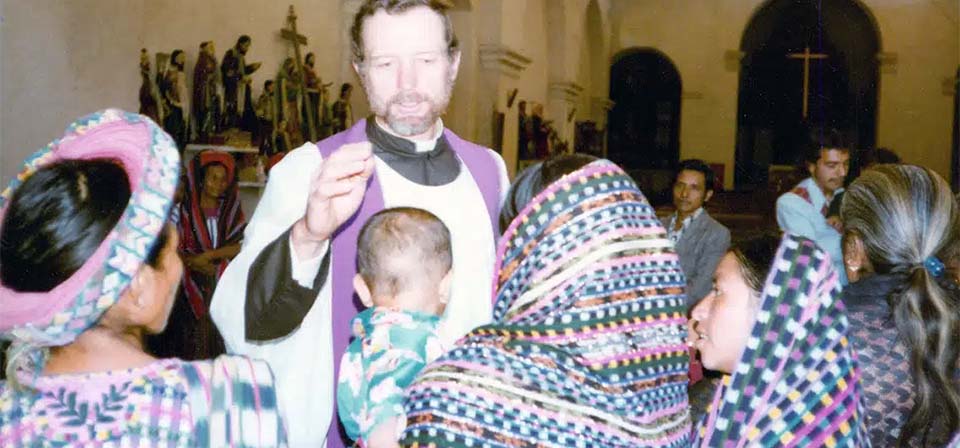
Since I am an immigrant and a refugee, of course I agree—but, more than awareness, what I’ve been emphasizing is Fr. Stan’s gift of presence to his people. He was God-in-the-skin for them, and he models how to do that for us: a shepherd who did not run, who returned to be fully with them, especially in their suffering. This is the image of God that Fr. Stan embodied for them, for us, all the way to his martyrdom.
Many Latinos in the U.S. today are concerned about rising discrimination and hate crimes as well as government policies. Does Fr. Stan’s witness have anything to say to us in this time?
I’ve always considered my Spanish culture—my language, my music, and certainly food—part of who I am, and I can turn around and recognize that in other [Hispanic] people. Fr. Stan, as this white farmer from Okarche, didn’t start with that kind of kinship—but he developed it. At the mission, he found that he and the people could become one through our faith, through the things that really matter. I want to learn how to do that better myself.
That’s beautiful. Fr. Stanley was one of those people who, as Pope Francis used to say, sought to build bridges between different communities. There are also those who burn bridges—like those who took his life.
Yeah, and by the way, it wasn’t just Guatemala. We know about El Salvador from Archbishop Óscar Romero. All of Central America was kind of on fire during that period. Fr. Stanley was killed just a year after Romero.
It’s funny you mention St. Óscar Romero, because I was going to ask you to comment on the similarities and differences in their stories! I was definitely reminded of Romero’s story watching the film.
Is that right? I mean, how could you not? They were both reluctant leaders against what was going on at the beginning. Once they realized what their faith and God’s voice inside them were leading them to, they lived that courage to focus on God and not on what could happen. Most of us are not going to be put in that position—but we’re all in the position of figuring out how to live our faith more fully. How am I going to love the people that are prejudiced, the people that try to be demeaning, because you’re not from where they are?
Fr. Stan wasn’t a national leader like Romero, but he was concerned both with the spiritual well-being of his people and their socioeconomic well-being.
He definitely could see how they could improve. He truly was a farmer. The co-op was one step, so they weren’t just working for whoever owned the land, but for themselves. He would come home to Oklahoma, find out what equipment his neighbors were no longer using, and bring all that back to Guatemala. Can you imagine hauling things like that across Central America?
I personally cannot, I’m afraid!
Me either. But I like the vision of it.
I can’t resist asking this: As a seminarian, Stan flunked out of Assumption Seminary in Texas and was asked to leave. Only the support of Bishop Victor Reed led to Stan completing his studies at Mount St. Mary’s and becoming a priest. Has anybody ever gone back to Assumption Seminary and asked whether they have any second thoughts or recriminations about sending him away?
(Laughing) You know, I had to do some research on that! I found it hilarious that they have a list of alumni: how many priests they educated; how many became bishops; how many became … whatever it is; and it ends with … one martyr.
(Laughing) Oh, they’re counting him!
Yes! Even though they sent him packing! I love to point out, just as you did, that Stan did flunk out of first year theology. When I’ve been speaking to seminarians, some will come to me afterwards and go: “Me too! I’m still here, but me too.” I think we all find comfort in that part of him.
Related
American Martyr: An Oklahoma priest’s unlikely bond with persecuted Mayans in war-torn Guatemala
As with most martyrs, while Fr. Stan may be remembered first of all for how he died, what matters most is how he lived. American Martyr: The Stanley Rother Story is concerned with what matters most.
Recent
- ‘Those books created me’: Greta Gerwig on Narnia: The Magician’s Nephew
- American Martyr: An Oklahoma priest’s unlikely bond with persecuted Mayans in war-torn Guatemala
- Father Stanley Rother’s gift of presence: Interview with María Ruiz Scaperlanda
- The Odyssey and the consequences of war
- Why Doctor Strange is the best MCU movie: 10 reasons
Home Video
Copyright © 2000– Steven D. Greydanus. All rights reserved.