American Martyr: An Oklahoma priest’s unlikely bond with persecuted Mayans in war-torn Guatemala
It’s a wonder that Blessed Stanley Rother ever became a priest in the first place. A farm boy from a Catholic enclave in rural Okarche, Oklahoma, Stanley had a sturdy work ethic and a resilient spirit as well as deep piety. He was confident in his calling, but he wasn’t a scholar and he hadn’t studied Latin, which was still de rigueur in those days on the eve of Vatican II. After years of struggling for passing grades at Assumption Seminary in San Antonio, Texas, he was asked to leave the formation program.
What did Bishop Victor Reed see in this unpromising student that moved him to go to bat for the young man? How did Stanley wind up attending another seminary, Mount St. Mary’s in Maryland, completing his studies and receiving ordination in 1963? Whatever other factors played a role, in view of what followed, it is not hard to discern the hand of God in Stanley’s ordination during the Council that would play a decisive role in the shape of his future life as well as his 1981 martyr’s death in Guatemala and the devotion that has grown around him.
As with most martyrs, while Fr. Stan may be remembered first of all for how he died, what matters most is how he lived. American Martyr: The Stanley Rother Story is concerned with what matters most.
We expect a documentary like this to offer a blend of archival video and still photography, location shooting, dramatized recreation video, voiceover narration—provided here by Martin Sheen—and interviews with knowledgeable sources. In this case, sources include Sister Marita Rother, ASC, Stan’s sister; biographer María Ruiz Scaperlanda, who served on the historical commission gathering data for Stan’s cause for sainthood; and Archbishop Paul Coakley of Oklahoma City.
American Martyr rises above expectations in moments of unexpected poignance. A cousin in Okarche chokes up relating the last time he talked to Fr. Stan during a brief return to the U.S. after learning that his name was on a government hit list. Regarding Stan’s intent to return to celebrate Holy Week with his Mayan parishioners, his cousin recalls him saying, “You have your family, and I have my family.” Another such moment comes with the confession of a middle-aged Guatemalan man who was a teenaged catechist the night gunmen came to the rectory looking for Fr. Stan. To this day, he admits, he feels like Judas Iscariot for leading the assassins to their sleeping victim.
Director Derek Watson, founder of Oklahoma-based Lampstand Story Co., previously directed a related documentary short, “An Ordinary Martyr: The Life and Death of Blessed Stanley Rother,” which premiered at the 2017 beatification. The care that Watson and director of photography Michael Zurbach put into crafting their visual approach goes beyond most faith-based documentaries. Well-composed recreation shots of Stan as a child or a young man in Okarche are bathed with a nostalgic, golden glow. Archival photographs are sometimes presented in direct, full-frame view, often with a Ken Burns–style slow dolly; other times, they are visualized in a diegetic context: for example, placed on a desk amid other paraphernalia, as if someone had just been looking at them. During Stan’s seminary schooling, the photos are set amid well-worn textbooks; when he arrives in Guatemala, the backgrounds include colorful local textiles.
What brought an Oklahoma priest to Guatemala? In the wake of the Second Vatican Council, the Holy See called on the dioceses of North America to come to the aid of Catholics in Latin America. Fr. Stan joined a mission team organized by the dioceses of Oklahoma City and Tulsa to the remote Guatemalan town of Santiago Atitlán, a poor community on a volcanic lake. The town was populated largely by indigenous Maya; some spoke Spanish as a second language; others spoke only the Tz’utujil language.
Fr. Stan’s working-class background as well as his priestly ministry made him a valuable servant to the Tz’utujil people. Using church funds, he created a farming co-op where laborers could work for themselves instead of living in feudal dependence on landowners. He helped build up infrastructure in the region, including housing, an irrigation system, and medical services. He trained Mayan catechists who could teach people in Tz’utujil; eventually he learned the language well enough to say Mass and preach in it, ultimately even becoming a driving force in translating the New Testament into Tz’utujil—quite a feat for the former seminarian who struggled with Latin.
Fr. Stan also established a radio station that became an important source of news as well as catechesis—a development that American Martyr connects to growing hostility from the repressive military government, whose forces finally made their way to the isolated community. Backed by the U.S. in its proxy war with the Soviet Union, and opposed by leftist guerrillas, the government carried out a program of genocide against the Maya, from whom, they alleged, rebel groups recruited.
In his efforts to defend his people from a U.S.-backed Latin American military government, leading eventually to his martyrdom, Fr. Stan becomes something of a low-key, parochial counterpart to El Salvador’s St. Óscar Romero, Archbishop of San Salvador. Romero had much more pastoral responsibility and a formidable soapbox; he was also far more outspoken and direct in condemning the government’s atrocities and appealing directly for an end to violence. A parish priest of a tiny rural community, Fr. Stan hoped that he and his people would be overlooked as much as possible … and, for a long time, they were.
When military intimidation came to Santiago Atitlán, and people in the area started disappearing and being tortured or killed, Fr. Stan opposed the military occupation of the town, and still more their presence on his co-op farm. He also spoke out in defense of the rights and the dignity of his parishioners and in opposition to violence. With his status as an American came some protection, but he wasn’t untouchable, and he knew it.
American Martyr doesn’t overlook the symbolism of Fr. Stan returning from his brief trip to the U.S. to Guatemala to celebrate Holy Week. Armfuls of palm branches clutched by Mayan Catholics in a Palm Sunday celebration highlight the connection between Jesus’ Passion and that of the Oklahoman priest. He wouldn’t die that week, or that month; indeed, he dared to hope that he would be allowed to live and continue to serve his community. But his commitment to be present to his people, and to offer them what strength and encouragement he could by his presence, was a calling he was willing to die for.
Fr. Stan’s personality is sufficiently vivid in American Martyr that it’s ultimately a surprise to realize that we have never so much as heard his voice—and that the man is glimpsed in motion in no more than, I believe, two or three brief clips of silent archival video (perhaps 8mm film): one capturing him processing apparently on the day of his ordination; another finding him celebrating that last Palm Sunday in 1981. An echo of his voice is heard in readings from his letters. There is apparently a wealth of audio of Fr. Stan’s voice—in Guatemala, from Stan’s radio broadcasts, probably all in Tz’utujil or Spanish.
Who he was, ultimately, is his gift to the people of Santiago Atitlán. His challenge to us, perhaps, is this: How are we called to give ourselves to others? What price are we willing to pay?
Related
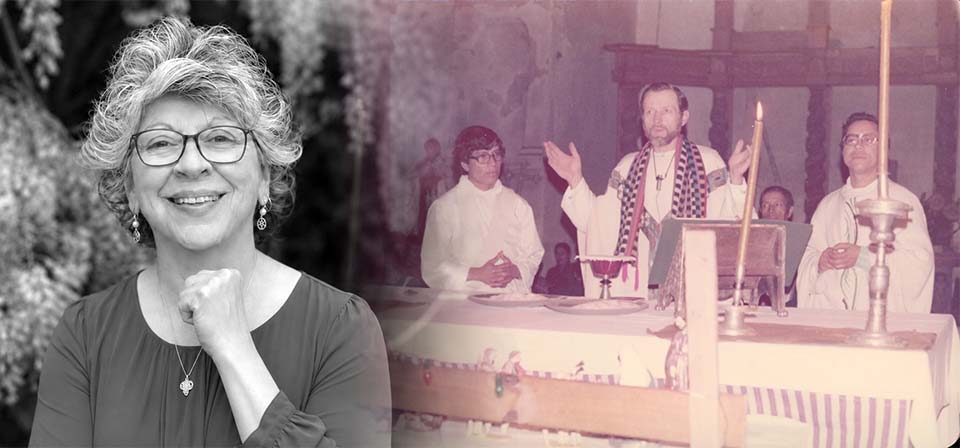
Father Stanley Rother’s gift of presence: Interview with María Ruiz Scaperlanda
Catholic writer María Ruiz Scaperlanda is an enthusiastic voice for Blessed Stanley Rother—one you can hear in the documentary American Martyr, which features her prominently.
Recent
- ‘Those books created me’: Greta Gerwig on Narnia: The Magician’s Nephew
- American Martyr: An Oklahoma priest’s unlikely bond with persecuted Mayans in war-torn Guatemala
- Father Stanley Rother’s gift of presence: Interview with María Ruiz Scaperlanda
- The Odyssey and the consequences of war
- Why Doctor Strange is the best MCU movie: 10 reasons
Home Video
Copyright © 2000– Steven D. Greydanus. All rights reserved.