Hungering for a sense of grace: Interview with Wake Up Dead Man writer-director Rian Johnson
Rian Johnson identifies as agnostic today, but clues of his evangelical Protestant upbringing peek through the cracks of more than one of his films. Most notable, until now, was a subtle use of a song by Larry Norman, the “godfather of Christian rock,” in a restaurant scene in Knives Out, a delightful 2019 murder mystery starring Daniel Craig as gentleman sleuth Benoit Blanc. There’s a second Norman needle drop in Johnson’s exhilarating new Knives Out threequel, Wake Up Dead Man — but Christianity is all over this film.
Wake Up Dead Man stars Josh O’Connor as an earnest young Catholic priest named Father Jud contending with a fearsome culture-warrior pastor played by Josh Brolin. Johnson has been frank in interviews about the necessity of reconnecting with his youthful passion for Christ to write Father Jud’s character. I spoke with him via Zoom about the influence of G.K. Chesterton, biblical themes in the film, and the meaning of grace for his detective hero and for himself. Our conversation has been edited for length and clarity.
Given all the religious press that you’ve done for this film, you’re well aware how much enthusiasm there is out there for the character of Father Jud. I wanted you to know that one of my Catholic followers on social media said this was the first film he’d ever seen that made him want to become a priest!
Wow! That’s incredible to hear. It’s hard for me to grasp the impact on anybody outside of myself. I know how making the movie made me feel. And I’m thrilled that people are having such strong reactions to it, particularly in the faith community. That’s honestly where so much of the hard work went into: reconnecting with the things I truly valued about being a Christian.
You’ve compared your approach to writing Father Jud to method acting. Mark Rothemund, the director of Sophie Scholl: The Final Days, told me 20 years ago that he was an atheist, but he said, “I believed in God the whole time I was making this movie.”
Yeah. That profoundly resonates with me. The method-acting analogy is apt but doesn’t quite get it, because a method actor is usually trying to find things in their experience that are analogous to what their character is going through. Writing Father Jud, it was really, for me, making an active effort to put myself back into the place I was when I was younger and when I was a Christian. I was not raised Catholic, but I was deeply, deeply Christian.
A big part of why I wanted to make the movie was I felt kind of a hunger for those things that I valued about my relationship with Christ. And, I have to say, it felt so good to be able to reconnect with that part of me and to channel it — specifically the parts of it I feel like I need more of in my life right now, if that makes sense.
You’ve mentioned G. K. Chesterton’s Father Brown mysteries as an inspiration; there’s even an explicit hat tip to Father Brown in this film. What about those stories played a role in your thinking while making this movie?
I had read the Father Brown stories in my 20s, but I reread all of them right before I started writing this film. Besides being great mysteries and great yarns, and Father Brown being a delightful character, the inspiration was twofold.
First, those stories were a true proof of concept that serious ideas of faith and morality can play well with an entertaining murder mystery — not just one wedged in the other, but like peanut butter and chocolate. The morality play of a crime mystery and a character who’s truly wrestling with humanity from the perspective of faith: Those two things can really lock together and serve each other.
The other thing was that Father Brown is a good detective because he’s a priest, yes, but not because he understands the perfect and divine. It’s because he understands the imperfect and the human, and he has empathy for it. He understands that man is sinful and fallen, and he isn’t pearl-clutching about any of that, but embraces that humanity as his true work.
Because I didn’t grow up Catholic, I wanted to get as much perspective as I could about the life of modern Catholic priests. My aunt and uncle, who I’m very close to, are devout Catholics. They were kind enough to have me over for dinner, and invited their priest and like five other young priests, and I got to talk to them. Something that struck me was how all of them — particularly Father Scott Bailey, who ended up consulting on the film — talked about meeting people where they’re at. That’s Father Brown right there.
The level of biblical and liturgical nerdery in the film is really high! From how closely the plot maps to the Holy Week liturgy, to a Pontius Pilate figure asking “What is truth?” and some confusion about a gardener at an empty tomb... I think my favorite detail, though, is the one that highlights what a farce this via dolorosa is, which is a literal whitewashing of a tomb.
The explicit thing of Jud saying, “If you can’t confess your deepest sin without fear, then this whole place is a whitewashed tomb,” was a late add! At first I had just had [the actual whitewashed tomb] as a low-lying Easter egg. But then I thought, no, it’s a good thing to point out. It absolutely delights me to hear you pulling out those references. It’s the sort of thing that I just baked into it hoping it would have an overall effect on audiences, and maybe a few Bible wonks would grab it.
The second movie, Glass Onion, ends with a revenge-driven, destructive finale I’m not crazy about. But watching these two films together, I feel like Blanc, like all of us, is on a journey — in this case, from revenge to grace and mercy.
Yeah. It feels good to close it off there... not close it off! I’ll hopefully make more of these. But, for this film specifically, that was the thing I’m proudest of. I’m always trying to get like that perfectly satisfying ending, like the feeling I had as a kid at the end of E.T. — that’s sort of the high that I’m chasing in movies.
With this movie, what I was chasing was that feeling of... I know “grace” can be a stretchy word, but I mean it in a specific way. I was looking for a sense of grace in the way that I approached the world; I was hungering for that. And to have Blanc start the movie where he does, and then end it on that note of true grace, giving up the thing that he values the most in order to give a person who, from his perspective, deserves it the least and is his enemy — to give that person a moment of forgiveness and grace at the end of their life — that felt really, really good to me.
It’s an expression of what I think is one of Blanc’s defining character traits, which is his empathy. In this case, his empathy for Father Jud causes him to see the world a bit the way that Father Jud does, and that has a lasting effect on him, I think.
Yeah, and the other thing that I like, because I think this is very, very true in my experience, is it’s not because Father Jud said something to Blanc. It’s through seeing Father Jud’s actions.
Well, having arrived at this road-to-Damascus moment, where is there for Blanc to go?
(Laughing) I’m going to take a breath and just enjoy where he’s at right now! Making this film was a more exciting, fulfilling experience for me, engaging with this issue of faith that was such a big thing in my life. I feel exhilarated, like, “Okay, what else can these movies engage with?” But I don’t know what that is yet. I’m going to take a bit of a break and write something totally different. But hopefully down the line I’ll figure it out.
Related
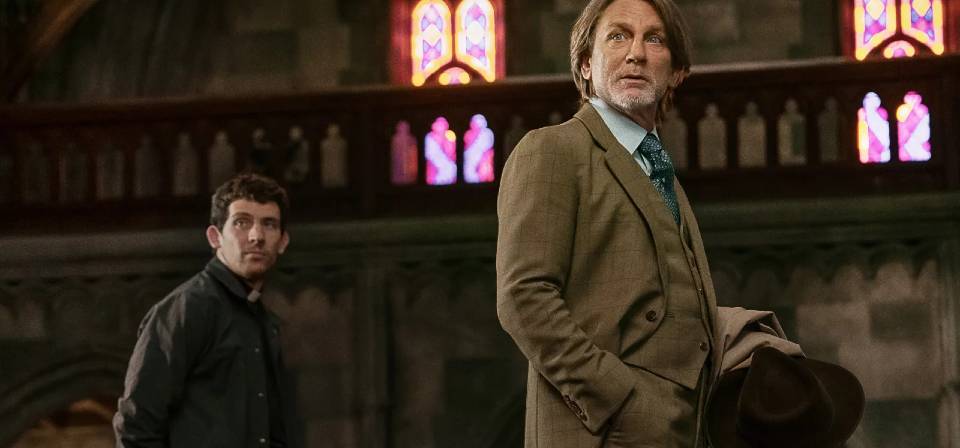
Benoit Blanc goes to church: Mysteries and faith in Wake Up Dead Man
Wake Up Dead Man is about an impossible murder, among other impossible mysteries; it is also about the sociopolitical implications of two opposing conceptions of Christianity and of Catholicism in particular.
Recent
- American Martyr: An Oklahoma priest’s unlikely bond with persecuted Mayans in war-torn Guatemala
- Father Stanley Rother’s gift of presence: Interview with María Ruiz Scaperlanda
- The Odyssey and the consequences of war
- Why Doctor Strange is the best MCU movie: 10 reasons
- Aliens, humanity, and God: In Disclosure Day, Spielberg still wants to believe
Home Video
Copyright © 2000– Steven D. Greydanus. All rights reserved.