The Bourne Ultimatum (2007)
We’ve seen him effortlessly take out multiple assailants at once, battle highly trained assassins to the death, and negotiate harrowing multi-vehicle urban chases. He’s avoided nearly certain capture, vanished in plain sight amid heavy surveillance, even deliberately allowed himself to be taken into custody before escaping at will. He’s a nearly unstoppable force, despite only patchy memories of his prior life.

Caveat Spectator
Much intense hand-to-hand, firearm and vehicular violence; recurring glimpses of torture; execution/murder of a prisoner; some profanity and crass language.Other Hollywood heroes might be able to say much of this, but now with The Bourne Ultimatum the eponymous hero accomplished something rare indeed: Jason Bourne has gone the distance for three straight films. With The Bourne Identity and The Bourne Supremacy, The Bourne Ultimatum seals the achievement of a rare action franchise for thinking adults, combining gripping entertainment with an undercurrent of moral seriousness.
In the five years since its release, Doug Liman’s The Bourne Identity has grown in my appreciation, with its robust overarching premise, compulsively watchable set pieces and vivid location shooting. The first sequel, The Bourne Supremacy, directed by Paul Greengrass (United 93), seamlessly builds upon and extends the first film’s achievement. Though lacking a key relationship that helped anchor the first film, the sequel goes further in humanizing its hero while maintaining the same level of white-knuckle excitement.
The Bourne Ultimatum, again directed by Greengrass, sustains the series hallmarks of comparatively restrained realism, ferocious intensity, clever tactical thinking, and a subtext of thoughtful humanism. Unlike the cartoon antics characterizing most of the James Bond franchise, the Bourne films know that keeping the action more or less human-scaled makes it more thrilling than pumping it up with over-the-top stunt sequences that could only exist in a movie fantasyland (despite a few scenes that cross the line). They also know that real characters and emotions are more engaging than casually detached womanizing and interchangable playmates.
The Bourne Ultimatum furthers Bourne’s moral trajectory as he struggles not only to discover who he was, but also to decide who he ought to be. The first film suggested an underlying decency in a man whose character was a mystery to himself (“I’m just trying to do the right thing here,” he told Marie, and in the end we learned that it was resistance to doing the wrong thing that got Bourne dumped in the drink in the first place). In The Bourne Supremacy, remarkably, Bourne led his black-ops pursuers on a breakneck chase as he delved into his past for information on an early hit assignment — not to compromise anyone involved in the now-defunct hit squad Treadstone, as his pursuers feared, but to locate the next of kin to the people he murdered and… confess and apologize for his acts.
Now, in The Bourne Ultimatum, Bourne confronts the implications of his own involvement in Treadstone. How did he get to be a CIA hit man in the first place? What does that say about who he was before his bout with amnesia, and about who he truly is today? What was done to him to make him what he was, and what is his own moral responsibility?
The answers aren’t surprising. There’s a revelation identical to a parallel discussion in X2 involving another amnesiac hero, Wolverine, and his unknown creator. (Albert Finney here plays the role that in X2 was played by Brian Cox, who coincidentally played a similar character in the first two Bourne films.) At the same time, Ultimatum suggests that unprincipled assimilating tactics can mitigate an individual’s culpability for choices made under duress, but doesn’t exempt the assimilated from the obligations of conscience under the rubric of following orders. Bourne’s defining victory is not a tactical or martial one, but a moral one; his climactic confrontation with a former peer sent to kill him takes a dramatically different form from the deadly combat that all previous such confrontations have taken.
The Bourne Ultimatum goes further into the ruthless expedience of the world of covert intelligence, in the process touching on such topical subjects as torture, extraordinary renditions and covert surveillance. Glimpses of waterboarding and hooded prisoners enhance the resonances with current events, though the angle is humanistic rather than political.
All of this is a notable level of subtext in what continues to be one of the most action-driven series of all time, with one heart-pounding set piece following another almost without interruption in locations all over the world: London, Paris, Madrid, Morocco, New York.
As usual, Bourne’s first weapon is his brain. He shows us how a man can become invisible by the simple act of tying his shoe, and how to hold a coversation of sorts with a reporter whose every line of connection to the world is being monitored. On the other hand, he isn’t infallible; there are setbacks, and more than once a hostile asset kills someone Bourne is trying to protect, on one occasion even outsmarting Bourne and maneuvering him into inadvertently assisting the hit.
As with previous installments, when there is violence, it’s grim, brutal, and direct, without the dramatic flourishes and conceits of fisticuffs in popcorn movies like Die Hard. A harrowing battle with a very tough opponent in Morocco may leave you exhausted rather than exhilarated, which is arguably a more moral approach to violence than the typical action movie.
With Treadstone shut down and CIA heavies Cox and Chris Cooper out of the picture, who’s sending the muscle after Bourne now? Meet the new boss, same as the old boss. Treadstone’s charter has essentially been resumed under the code name Blackbriar with a pair of ethically challenged administrators (David Strathairn and Scott Glenn) at the helm, and once again straight agent Pam Landy (Joan Allen) may be in a puddle too deep for her shoes.
Julia Stiles, who had one of the second film’s best-acted scenes, again makes a vivid impression as psych expert Nikki Parsons. She’s got a bigger part this time around, and could almost fill the void left in the series by the loss of Marie (Franka Potente) in the previous film, but the film doesn’t quite allow her to.
The producers say that The Bourne Ultimatum concludes the series, and in a sense it surely does. The story of the amnesiac CIA black-ops agent who knew himself only as Jason Bourne is complete; what began with an unconscious, anonymous figure floating in the Mediterannean with two bullet holes in his back ends with a single gunshot and another body of water. With the rest of the film, it’s a gripping, satisfying climax to a trilogy that stands as possibly the best-sustained such effort in the annals of Hollywood action moviemaking.
Related
![Jason Bourne [video]](/uploads/articles/jasonbourne_3nwIZ0n.jpg)
Jason Bourne [video]
You know his name. David Webb. You did know that was his name, right?
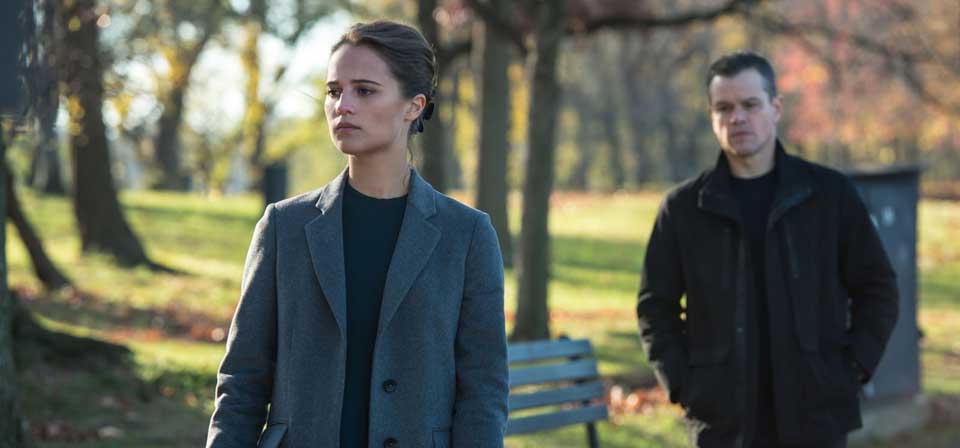
Jason Bourne (2016)
The world has changed since 2007, and not only in the ways the filmmakers are self-consciously trying to engage: concerns about cyber-security, online privacy, government spying and the pressure on tech companies to give the government whatever information or access it wants.
The Bourne Supremacy (2004)
Jason Bourne (Matt Damon) has come a long way since he was fished out of the ocean with a pair of bullet holes in his body and even bigger holes in his memory. His past is still a blank, mostly, but he’s finally fully in command of his devastating training and skills as a CIA black-ops agent. These days, when he kicks into high gear, it’s by design, not reflex.
The Bourne Identity (2002)
Like the memory-impaired antihero of Memento, the protagonist of Doug Liman’s The Bourne Identity (and a trilogy of Robert Ludlum novels before that) has no choice but to trust himself even though he can’t be sure he’s a trustworthy individual. Perhaps his honorable aspirations themselves are a good sign. Certainly the amazing abilities and instincts that suddenly surface when needed are clues to who and what he is. Jason may not know much, but he’s pretty sure he’s something out of the ordinary.
RE: Casino Royale, The Bourne Ultimatum
Link to this itemReading your review of The Bourne Ultimatum made me wonder if you had yet seen the 2006 version of Casino Royale. The following paragraph, especially the last sentence, makes the entire franchise sound goofy, but the latest film makes sense of the character’s whole morality:
Unlike the cartoon antics characterizing most of the James Bond franchise, the Bourne films know that keeping the action more or less human-scaled makes it more thrilling than pumping it up with over-the-top stunt sequences that could only exist in a movie fantasyland (despite a few scenes that cross the line). They also know that real characters and emotions are more engaging than casually detached womanizing and interchangeable playmates.I know you have never reviewed any of the Bond movies, but could you give your thoughts on that one, please?
RE: The Bourne Ultimatum
Link to this itemGreat review of The Bourne Ultimatum. I saw it and loved it. I also thought that the Julia Stiles subplot was not fully developed, though it seemed like maybe they left it open for possible future films.
But my reason for writing is actually mostly about a particular filming technique that is more and more prevalent. I personally loathe the super shaky hand-held camera work during action and chase sequences and everyone I talk to seems to agree. Yet, it seems to be worse with every new movie. I was wondering what your thoughts were on that?
Recent
- Benoit Blanc goes to church: Mysteries and faith in Wake Up Dead Man
- Are there too many Jesus movies?
- Antidote to the digital revolution: Carlo Acutis: Roadmap to Reality
- “Not I, But God”: Interview with Carlo Acutis: Roadmap to Reality director Tim Moriarty
- Gunn’s Superman is silly and sincere, and that’s good. It could be smarter.
Home Video
Copyright © 2000– Steven D. Greydanus. All rights reserved.