Horror, the grotesque, and the macabre: A Christian appraisal
Horror represents a field many Christians approach with trepidation, and rightly so. The horror shelves of bookstores and video stores are very largely a wasteland of mindless, tasteless trash; indeed, there may be no other genre as disproportionately overrun with junk.
Yet the grotesque, the macabre, and the frightful have an abiding place in human imagination and culture — a place that Christian sensibility has historically not seen fit to reject or condemn, at least entirely.
In the Middle Ages, gargoyles and grotesques were prominent features of sacred architecture. The danse macabre or “dance of death” — a dramatic or artistic representation of men being visited by Death, fruitlessly attempting to resist or escape, and finally being away in a grim procession or dance — was a popular art form.
More recently, the Vatican recognized the first great horror film, F. W. Murnau’s vampire film Nosferatu, in its 1995 list of 45 great films. Another Vatican list honoree, The Seventh Seal, offers a cinematic take on the danse macabre.
In Christian households, untold generations of children have been raised on fairy tales featuring all manner of goblins, dragons, witches, and so on. In the age of film, this roster of nursery monsters includes such figures as the winged monkeys and Wicked Witch of the West in The Wizard of Oz and the raucous hellions and demon Chernobog of the “Bald Mountain” sequence in Fantasia (two more Vatican list honorees).
The grotesque does have a disturbing and objectionable side. In too many books and films, villains become heroes, imaginative engagement of evil becomes glorification of evil, and mayhem and gore become ends in themselves apart from any sense of artistic restraint or moral context. I’ve seen none of the films in the Saw or Hostel series, but it’s hard for me to imagine that they aren’t as execrable as the label “torture porn” would suggest. The celebratory vampire novels of Anne Rice and gruesome slasher flicks like the Nightmare on Elm Street series would also seem to fit the bill.
But not all horror films and novels deserve such censure. For example, there is much to appreciate in the original Universal horror films of the 1930s and 1940s, especially James Whale’s Frankenstein, as well as Dracula, The Wolf Man and The Mummy, among others. Among more recent fare, an eclectic list of films I appreciate might include The Silence of the Lambs, The Sixth Sense, The Exorcism of Emily Rose, Tim Burton’s Corpse Bride and District 9.
It is possible to reject all of this root and branch. To be really consistent, though, anything that looks or smells of horror will have to go: every production of Shakespeare’s Macbeth and Hamlet, with the witches’ blasted heath of the former and the spectral visitation of the latter; the climax of Raiders of the Lost Ark, with the Nazis’ melting faces and exploding heads; every incarnation of Dickens’ A Christmas Carol, with the deathlike specter of Christmas Yet to Come; the satanic “boo” moments in The Passion of the Christ.
Some critics even found the scourging scene in The Passion, among others, to be reminiscent of horror, though this is probably pressing the point too far. Nor will we have much success looking for literary horror effects in the Bible, despite all the gruesome violence in Judges and elsewhere, simply because biblical literature is among the least descriptive and sensibly evocative literature in history. There is at least one moment, though, when a rare biblical appeal to the senses hovers on the edge of a spine-tingling special effect: the skeletal rattling sound in Ezekiel’s valley of dry bones as bone joins to bone, followed by sinews, then flesh, and finally skin, but without the breath of life.
At any rate, the complete rejection of the macabre in art will strike many thoughtful Christians as throwing out the baby with the bathwater. Despite the perversity of much modern horror, the principle abusus non tollit usam applies: The abuse does not abrogate the proper use. Neither uncritical acceptance nor uncritical condemnation is called for, but critical discernment and moral vigilance. I’m not recommending horror to anyone disinclined to be exposed to it. I’m simply counseling prudence in forming moral judgments about what horror essentially is, about its raison d’être, about what it offers to audiences.
But what is the “proper use” of the grotesque and macabre in imagination and culture? Perversity aside, what is its raison d’être? Why do people scare themselves with tales like Dr. Jekyll and Mr. Hyde, Frankenstein, Dracula, and so on?
Part of the answer is that there’s simply something cathartic and energizing about stories of danger, stress, and excitement. In journeying with the heroes into the valley of the shadow of death and emerging again, we participate vicariously in the triumph of good over evil.
Children, in particular, demand imaginary adversity in the course of developing the emotional resiliency to handle real-life difficulties and dangers — a point argued by Gerard Jones in his interesting book Killing Monsters: Why Children Need Fantasy, Super Heroes, and Make-Believe Violence. Adults, too, crave stories that frighten in part because such stories help us get a handle on real-life fears and anxieties. The simple fact is that we occupy a fallen world, and stories that reflect this reality in imaginatively compelling ways help us with the business of living in it.
But there’s more to it than mere adversity. If Nosferatu replaced Count Orlock with a mere serial killer, it would lose much of its power. Not just fear, but dread is necessary for horror, for in this world there are things not just fearful but dreadful.
Like the medieval danse macabre, horror at its best can be an imaginative way of grappling not only with adversity but with the specter of our own mortality, and the moral and existential implications of the fact that we will die. In his Letter to Artists, Pope John Paul II noted, “Even when they explore the darkest depths of the soul or the most unsettling aspects of evil, artists give voice in a way to the universal desire for redemption.” Horror author Stephen King, in his book Danse Macabre, put it this way:
Horror movies do not love death, as some have suggested; they love life. They do not celebrate deformity, but by dwelling on deformity they sing of health and energy. By showing us the miseries of the damned they help us rediscover the smaller joys of our own lives. They are the barber’s leeches of the psyche, drawing not bad blood but anxiety … for a little while anyway.Morally speaking, horror stories can be as scrupulous as fairy tales, and in the same way, punishing those who transgress moral boundaries. This is especially the case, as Catholic culture critic E. Michael Jones argues in his provocative book Monsters From the Id: The Rise of Horror in Fiction and Film, in regard to moral boundaries that are in the process of being questioned or challenged in the culture at large.
In general, moral transgression per se as a plot point in a story does not elicit dread, though it may elicit condemnation or even revulsion. Similarly, we’re fairly comfortable with seeing the unquestionably guilty punished, while the suffering of the unquestionably innocent tends to elicit sympathy and sorrow rather than dread.
But as taboos fall and men exchange truth for lies, the moral knowledge inscribed on the human heart by our Creator is suppressed but not entirely eradicated. Not moral transgression as such, but the gnawing fear that we as a society have lost our way and no longer know where the true moral boundaries lie, is what we most dread. When horror confronts audiences with the punishment of those whom, from Dr. Frankenstein to promiscuous teens in a slasher film, the audience feels on some level to be guilty but may not be able to unambiguously judge as such, dread and horror is the result.
In the 1940s, when moral taboos against nonmarital sex were much more taken for granted, one might have a film or book in which the wanton were punished and the chaste rewarded, but it would be a morality-tale or parable, not a horror story. As moral norms shifted, however, what was once regarded as sexual immorality became increasingly associated with horror, as slasher films like John Carpenter’s Halloween, the promiscuous die and the virgins survive. The unacceptability of fornication was no longer an idea that enjoyed common acceptance in society, yet on some level society was not entirely reconciled to the new ethic, and the image in the film expressed with inchoate fairy-tale directness something that was felt to be true but could no longer be straightforwardly affirmed.
Jones’s thesis is that the whole taproot of modern horror is the modernist secular morality of the Enlightenment, especially regarding sexual morality. He argues, with varying degrees of plausibility, that horror stories from Frankenstein and Dracula to Psycho and Alien are all rooted in shifting sexual mores.
For example, analyzing Alien, Ridley Scott’s 1979 science-fiction horror film, Jones draws attention to images in the film suggestive of conflicted attitudes toward procreation, childbirth, unnatural and contraceptive sex acts, and abortion.
Above all, the central image of a deadly alien embryo implanted in a character’s torso, maturing and finally bursting obscenely forth, amounts to a hideous perversion of pregnancy and childbirth. The face-sucking alien’s means of reproduction, inserting its reproductive member down a crew member’s throat, is evocative of fellatio, though in this case due to the sci‑fi element the act is not infertile. And when the final alien is destroyed by being sucked out of the ship, dangling on an umbilical-like cable until being shredded in the ship’s jets, it’s a remarkably abortion-like death.
In a key exchange, a treacherous android favorably contrasts the alien with humanity, calling it a “perfect organism,” a “survivor unclouded by conscience, remorse, or delusions of morality.” The clear implication is that unless we are guided by conscience and morality — unless we resist thinking of ourselves as mere “organisms” — we will be no better than monsters ourselves.
None of this is to say that the gruesome violence in films like Alien isn’t morally problematic. Even so, Alien illustrates that the fascination of horror and the grotesque cannot be simply dismissed as a mere disordered fascination with ugliness or evil, and echoes of unpopular and forgotten moral truths can be found in the most unlikely places.
Jonathan Demme’s The Silence of the Lambs is a remarkable film for many reasons, not least for Hannibal Lecter’s surprising two-word diagnosis of the serial killer Buffalo Bill: “He covets.” “Coveting” isn’t exactly a familiar term in Hollywood cinema today, but The Silence of the Lambs locates this concept, with all its decalogal overtones, at the root of Buffalo Bill’s murderous pathology, which also includes gender identity confusion and depersonalizing other human beings.
Horror often points to religion, and specifically Catholicism, as the only adequate response to all that is dreadful in the world. Terence Fisher, the director of horror films for the British Hammer Films company, often imbued the cross with a quasi-sacramental power over evil, depicting it as the ultimate weapon in the war against powers and principalities. Fisher has called his films “basically morality plays” that reflect his personal belief in “the ultimate victory of good over evil,” and the star of Fisher’s Dracula films, Christopher Lee, has cited the ultimate destruction of evil in Fisher’s films as the reason “the Church doesn’t object to these films, and why they are so popular in Ireland, Spain and Italy.”
As problematic as it is in many ways, The Exorcist can be seen as a debunking of Enlightenment rationalism, a film in which postmodern areligiosity, the decline of marriage, casual dabbling in such occult phenomena as Ouija boards, and the therapeutic culture are all indicted in the growing nightmare of a bubbly, increasingly troubled girl whose single mother turns for help to doctors, tests, and prescriptions. “You just take your pills and you’ll be fine, really,” the girl’s mother promises, but part of the film’s brief is that pills aren’t the answer to everything, and faith and religion may have answers science doesn’t. Scott Derrickson’s The Exorcism of Emily Rose offers a thoughtful, overtly Christian-inflected dialogue between rationalism and the supernatural as different parties attempt to make sense of the fate of another troubled young woman as well as their own experiences of the uncanny.
As with many other things, I would not recommend horror as a major staple of one’s diet, any more than violent war films or other fare that depicts extreme suffering or is highly traumatic. Such fare should be taken in moderation, just as the films themselves must exercise restraint in dealing with their subject matter.
Taken in the right spirit, artistic explorations of darkness and evil should awaken in us the desire for redemption, as John Paul II has said — not desire for more darkness and evil. To the extent that Stephen King is right that horror movies love life and health rather than death and deformity, horror in moderation should make us crave goodness rather than more horror. We should be more appreciative, not less, of all that is true, honorable, just, pure, lovely, gracious, excellent and worthy of praise (Philippians 4:8).
Related
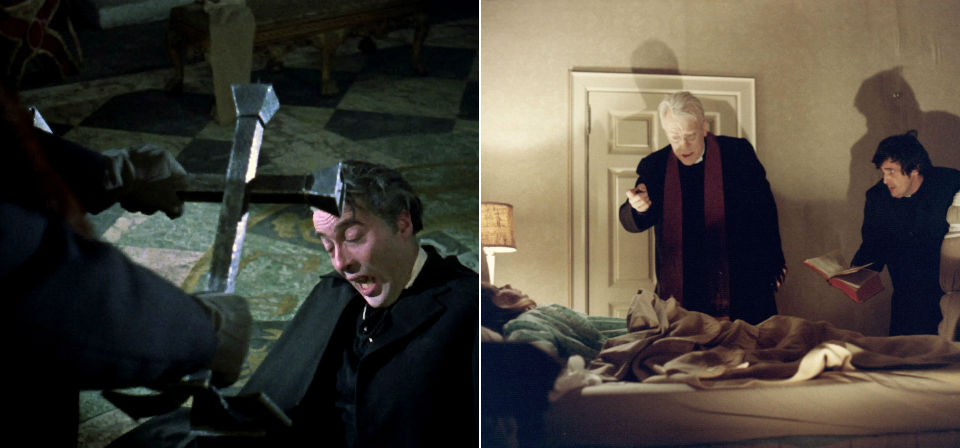
Vampires, demons and the cross: Catholicism and horror
“When it comes to fighting vampires and performing exorcisms, the Roman Catholic Church has the heavy artillery” is how Roger Ebert opened his review of John Carpenter’s Vampires.
Recent
- Benoit Blanc goes to church: Mysteries and faith in Wake Up Dead Man
- Are there too many Jesus movies?
- Antidote to the digital revolution: Carlo Acutis: Roadmap to Reality
- “Not I, But God”: Interview with Carlo Acutis: Roadmap to Reality director Tim Moriarty
- Gunn’s Superman is silly and sincere, and that’s good. It could be smarter.
Home Video
Copyright © 2000– Steven D. Greydanus. All rights reserved.