Ponyo (2008)
“Fish with human faces cause tsunamis,” an old lady in a nursing home warns five-year-old Sosuke, looking suspiciously at the thing swimming around in his bucket. Later, as his mother sets down a covered bowl of ramen noodles to steep in hot water, Sosuke solemnly tells Ponyo, “It takes three minutes.”
Noodles in three minutes. Fish with human faces. In a Hayao Miyazaki film, one is no more — or less — wondrous than the other.

Caveat Spectator
Mildly unsettling images; a few misanthropic references; potentially confusing depiction of a goddess-like character.As with the most childlike of the Japanese animation master’s previous films — My Neighbor Totoro, Kiki’s Delivery Service — the dreamlike quality of Ponyo is reflected in the way the magical elements seem not to come as a complete surprise, even to the grown-ups. It’s as if, in the world of these films, people are at least somewhat aware, whether or not they’ve seen it for themselves, that soot sprites scurry about in the attics of old houses, or that thirteen-year-old witches fly about on broomsticks.
But the deeper mark of a Miyazaki film is that the most ordinary elements are as attentively and lovingly portrayed as the fantastic ones. Ordinary daily rituals, architecture, mundane conversations, simple gestures like running up a flight of stairs or scrunching between the boards of a partially broken gate are all realized with a stylized hyperrealism — not ultra-realism, but realism pressed just beyond the breaking point — that is mesmerizing and wondrous.
Miyazaki typically blends reality (or realities) and whimsy with such seamless integrity that the worlds he fashions seem copied directly from life, even if the particular architectural, technological and cultural milieus he draws on never coexisted in any one place and time, or in some cases never existed at all.
In Ponyo, by contrast, the filmmaker has changed strategies, sticking together disparate bits and pieces of fairy tale, mythopoeia, sci-fi and family film with the artless simplicity of a child mashing up Tinkertoys, Playdoh and Daddy’s cuff links into a single sculpture. The result may not be a masterpiece, but it goes into realms of the heart and imagination untouched by Hollywood’s guinea-pig commandos and magical museum escapades. Only Pixar, where Miyazaki is revered and looked to for inspiration, can hold a candle to the Japanese animator’s restless creativity and consistent quality.
Borrowing a page from Hans Christian Andersen, Ponyo is a literal fish-out-of-water tale about a young girl of the sea, Ponyo, who chooses life on land after bonding with a human boy, Sosuke. (In Disney’s English dub, Ponyo and Sosuke are voiced by Noah Cyrus and Frankie Jonas — yes, kid siblings of Miley Cyrus and the Jonas Brothers.) But there’s also a gaudy submarine (in every sense) wizard named Fujimoto (Liam Neeson, bringing vocal masculinity to a somewhat androgynously animated male character), a Cambrian (or Devonian) riot of extinct fish roaming flooded streets, a discussion about breastfeeding, a maternal sea goddess (voiced by Cate Blanchett and called Gran Mammare in the credits, though not named in the English dub), and a toy boat powered by a candle, but also by a child’s imagination and Ponyo’s magic.
Added to this are a passel of typical Miyazaki themes including children taking on adult responsibilities, strong young heroines, sympathetic adult figures (including parents), respectful attentiveness to the elderly, ambiguous villains, environmental concern and a spiritualized, animistic vision of the natural world, above all in the dramatically zoomorphic depiction of the tempestuous sea during a storm.
If all this sounds complicated, it’s actually anything but. Ponyo is Miyazaki’s simplest, most unassuming and family-friendly picture in two decades, breaking with the darkly sophisticated approach of his last few films (the critically acclaimed Princess Mononoke and Spirited Away as well as the quirky Porco Rosso and the less successful Howl’s Moving Castle).
Which is not to say that it’s at all clear what’s going on. Is the strange behavior of the sea due to an accident involving Fujimoto’s elixirs or to Ponyo’s efforts to become human, or both? Is the sea out of balance, as Fujimoto says, or is this more or less what he was trying to do with his elixirs anyway? Granted that the union of an ex-human sea wizard and an enormous, shimmering marine goddess would produce a cloud of fry with children’s faces (well, why not?), why is Ponyo so much bigger than her siblings?
Although Ponyo seems as disjointed and free-floating as Howl’s Moving Castle, somehow the younger milieu here makes it more acceptable. Or maybe it’s just that there’s more here to latch onto emotionally.
Sosuke, reportedly modeled on Miyazaki’s now-grown son Goro, may be the director’s most endearing male protagonist, and his relationship with his capable, resilient mother Lisa (Tina Fey) recalls the delightful father–daughter dynamics of My Neighbor Totoro.
Sosuke’s father Koichi (Matt Damon), a fishing boat captain, is away at sea for the entire film, and Sosuke tries to play advocate for his father when Koichi’s prolonged absence results in a wincingly apt long-distance marital spat, with Sosuke and then Lisa using a signal lamp to exchange Morse code messages with Koichi’s ship. I don’t know what Lisa was signaling to her husband, but the furious speed with which she worked the lamp tells me all I need to know. (Note: The DVD edition supplies subtitles for Lisa’s staccato brush-off to her husband. They detract rather than adding.)
While all ends well on that front, it’s fair to say that Ponyo’s mother images (ideal mother Lisa; gracious Gran Mammare) are more positive than its father images (absent Koichi; strange-looking, deeply ambivalent Fujimoto). (For what it’s worth, Gran Mammare seems to be an absent parent too, but this doesn’t reflect on her.) In that connection, it’s worth noting that Miyazaki made Ponyo after an uncharacteristically public quarrel with his son Goro, which perhaps accounts for the subtext of paternal guilt running through the film. When Fujimoto humbly asks Sosuke, “Think well of me, if you will,” it may be Miyazaki’s apology to his son.
Meanwhile, many parents of both sexes (and many a child) will relate to Fujimoto’s struggle over Ponyo growing up — a struggle that at one point comes down to Fujimoto attempting to magically compel Ponyo to revert an earlier state. “Don’t change!” he grunts, straining against her magic. (Good luck with that.) “If you could only remain innocent and pure forever,” he sighs on behalf of parents everywhere, but of course it’s a misguided wish.
Ponyo’s minimalism extends to its design and animation. The absence of the computer-aided effects seen in Miyazaki’s last few films has been widely noted, but it’s more than that. The painterly density and extraordinary attention to detail that has been the filmmaker’s hallmark for decades has been substantially scaled back, with a simpler, sketchier style making bold use of colored pencils for a sort of storybook feel.
It’s still lovely work, though for Miyazaki fans such minimalism takes getting used to. (Compare Ponyo’s blob-like clouds with the gorgeous cumulus clouds floating through all other Miyazakis.) Watching Howl’s Moving Castle, it occurred to me that no matter how much of a mess a Miyazaki film might be plotwise, one could always lose oneself in his gorgeously rendered visuals. I could see someone considering Ponyo the exception to the rule.
Yet Ponyo is so charming, so loopy, so boldly imagined and lovingly mashed together, that its limitations recede and its strengths linger. Amid so much soulless, mass-produced Hollywood family product, here is a work of hand-crafted idiosyncrasy, with winsome characters, magical images and an appeal all its own.
Related
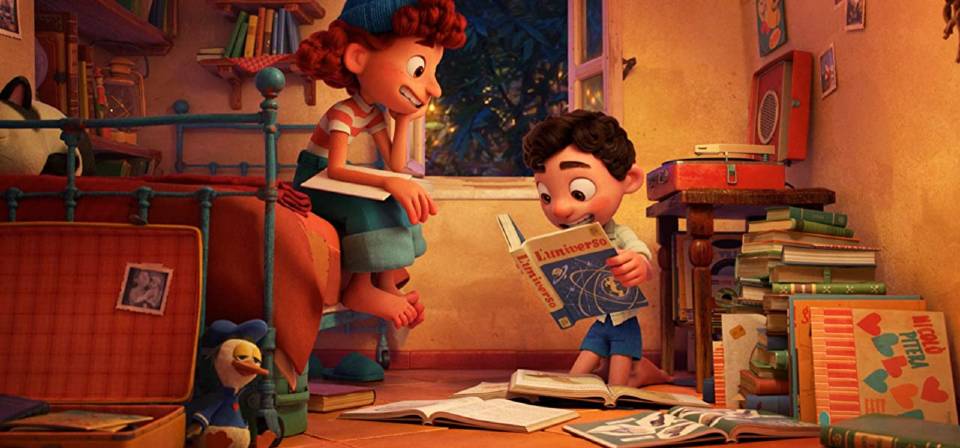
Luca (2021)
In Pixar’s Luca, a gentle, overtly Miyazaki-esque coming-of-age period piece struggles under the heavy weight of iron-clad Disney/Pixar formula requirements and story beats. The charming elements work well enough to carry the film, but only just.
Recent
- Benoit Blanc goes to church: Mysteries and faith in Wake Up Dead Man
- Are there too many Jesus movies?
- Antidote to the digital revolution: Carlo Acutis: Roadmap to Reality
- “Not I, But God”: Interview with Carlo Acutis: Roadmap to Reality director Tim Moriarty
- Gunn’s Superman is silly and sincere, and that’s good. It could be smarter.
Home Video
Copyright © 2000– Steven D. Greydanus. All rights reserved.